
Two Points (Fast & Slow Pointers, Cyclic detection)
The pattern
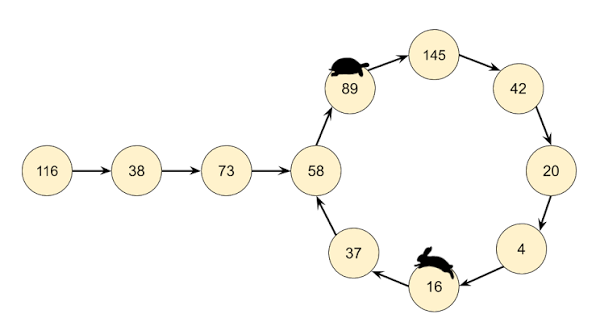
Two pointers walk the same sequence at different speeds. One takes a single step per iteration (the tortoise), the other takes two (the hare). That's it. Everything interesting follows from the speed difference.
The pattern applies whenever you have a successor function — a rule that maps each state to exactly one next state:
A linked list node →
node.nextA number → sum of squares of its digits
An array index
i→nums[i]
If the set of reachable states is finite and every state has exactly one successor, the walk must eventually revisit a state. Pigeonhole principle: you can only visit so many distinct states before you're forced to repeat one. And once you repeat one, you're stuck in a loop forever, because the successor is deterministic.
Why the pointers meet
Slow moves 1 step per iteration, fast moves 2. Once both are inside the cycle, the gap between them shrinks by exactly 1 each iteration. A gap that decreases by 1 every step and lives in a finite cycle must hit zero. They cannot jump over each other.
Contrast that with fast moving 3 steps: the gap shrinks by 2 per iteration and can skip past zero, so a meeting isn't guaranteed on the first pass around. Speed 2 is the choice that makes the proof trivial.
- The constraint
O(1) spacenext to any of the above. That constraint is the pattern announcing itself — the hash-set solution is always easier and always O(n) space.
| Problem | Link |
|---|---|
| Happy Number | https://leetcode.com/problems/happy-number/ |
| Linked List Cycle | https://leetcode.com/problems/linked-list-cycle/ |
| Is Subsequence | https://leetcode.com/problems/is-subsequence/ |
| Find the Duplicate Number | https://leetcode.com/problems/find-the-duplicate-number/ |
Problem 1 — Happy Number (Easy)
Repeatedly replace a number with the sum of the squares of its digits. Return
trueif the process reaches 1.
How it maps to the pattern
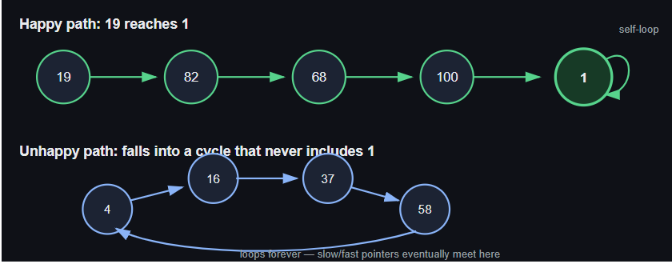
The successor function is n → sum of squares of digits. The key insight is that the state space is finite and small. For any 3-digit number the maximum output is 9² × 3 = 243. Any number with more digits shrinks rapidly, so after the first couple of steps every value lives below 243. Finite states plus a deterministic successor means the sequence must cycle.
So there are exactly two outcomes: the walk lands on 1 (a self-loop, since 1² = 1), or it enters some other cycle. Detecting which one is exactly the cycle-detection problem — no visited set required.
Approach
slow = n,fast = next(n)Advance slow once, fast twice, until
fast == 1or the pointers meetReturn whether we stopped because we hit 1
We only need phase 1 here. The entrance of the cycle is irrelevant; we just need to know which cycle we landed in.
Python
def is_happy(n: int) -> bool:
    def next_num(x: int) -> int:
        total = 0
        while x:
            x, digit = divmod(x, 10)
            total += digit * digit
        return total

    slow, fast = n, next_num(n)
    while fast != 1 and slow != fast:
        slow = next_num(slow)
        fast = next_num(next_num(fast))
    return fast == 1
Java
public boolean isHappy(int n) {
    int slow = n, fast = nextNum(n);
    while (fast != 1 && slow != fast) {
        slow = nextNum(slow);
        fast = nextNum(nextNum(fast));
    }
    return fast == 1;
}

private int nextNum(int x) {
    int total = 0;
    while (x > 0) {
        int digit = x % 10;
        total += digit * digit;
        x /= 10;
    }
    return total;
}
Complexity
Time: O(log n). Reducing n to below 243 takes O(log n) work, since each next_num call costs O(log x) and the value collapses quickly. After that, the walk is bounded by a constant (the cycle and tail both live in a fixed 243-element space).
Space: O(1). Two integers. The hash-set version is O(log n) space.
Problem 2 — Linked List Cycle (Easy)
Given the head of a linked list, determine if it has a cycle.
How it maps to the pattern
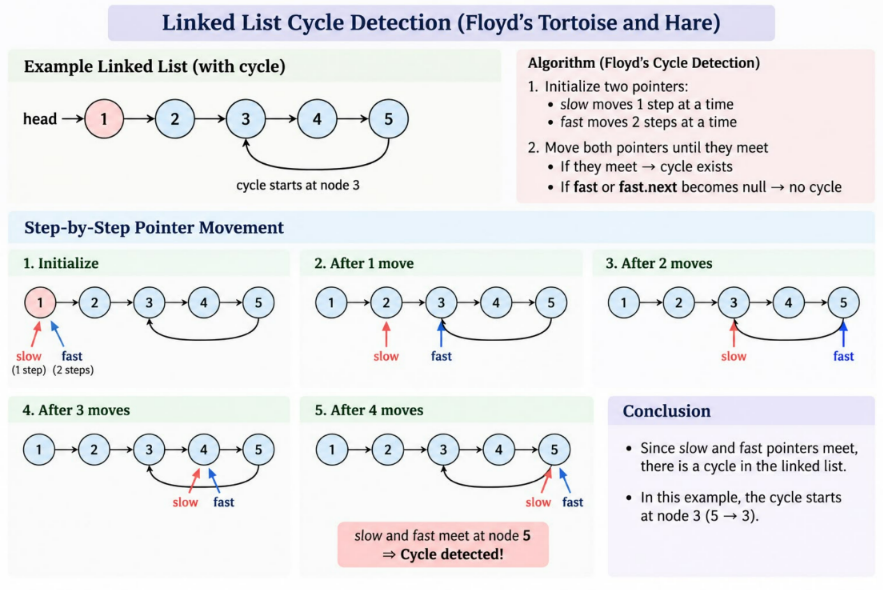
This is the pattern in its purest form — the successor function is literally node.next, and the question asked is literally "is there a cycle?" Every other problem in this list is a disguised version of this one.
Approach
Both pointers start at the head
Slow advances one node, fast advances two
If fast (or
fast.next) falls off the end, the list is acyclic — anullmeans no cycle existsIf the pointers ever hold the same node, there's a cycle
The null check is the whole implementation risk. Fast dereferences two links per iteration, so both fast and fast.next must be non-null before you move.
Python
def has_cycle(head) -> bool:
    slow = fast = head
    while fast and fast.next:
        slow = slow.next
        fast = fast.next.next
        if slow is fast:
            return True
    return False
Java
public boolean hasCycle(ListNode head) {
    ListNode slow = head, fast = head;
    while (fast != null && fast.next != null) {
        slow = slow.next;
        fast = fast.next.next;
        if (slow == fast) return true;
    }
    return false;
}
Complexity
Time: O(n). Slow travels at most μ + λ nodes before the meeting, and both are bounded by n.
Space: O(1). Compare to the hash-set approach, which stores every visited node — O(n).
Variant worth knowing: Linked List Cycle II asks for the node where the cycle begins. That's phase 2 — reset
slowtohead, advance both one step at a time, and return where they meet. Same code, four extra lines.
Problem 3 — Is Subsequence (Easy)
Return
trueif stringsis a subsequence of stringt.
How it maps to the pattern — with a caveat
Be careful here. This is not Floyd's cycle detection. There is no cycle, no successor function, and no rho shape. It's filed under Fast & Slow because it shares the mechanical idea of two pointers advancing at different rates over the same traversal — but the rates are data-dependent rather than fixed.
The pointer over t advances on every iteration (the fast one). The pointer over s advances only on a character match (the slow one). The gap between them is the number of characters in t we've skipped.
Worth saying out loud: if you go in expecting cycle detection here, you'll waste ten minutes looking for a cycle that doesn't exist. The useful generalisation is "unequal advancement," and cycle detection is one instance of it.
Approach
Pointer
iovers, pointerjovert, both at 0Scan
tonce. On a match, advancei. Always advancejsis a subsequence exactly whenireaches the end ofs
Greedy matching is correct here: taking the earliest possible match for each character of s never eliminates a valid later match, because any solution using a later occurrence can be rewritten to use the earlier one.
Python
def is_subsequence(s: str, t: str) -> bool:
    i = 0
    for ch in t:
        if i < len(s) and s[i] == ch:
            i += 1
    return i == len(s)
Java
public boolean isSubsequence(String s, String t) {
    int i = 0, j = 0;
    while (i < s.length() && j < t.length()) {
        if (s.charAt(i) == t.charAt(j)) i++;
        j++;
    }
    return i == s.length();
}
Complexity
Time: O(n + m) where n = |s| and m = |t|. Each pointer only moves forward, so the total work is bounded by the sum of the lengths.
Space: O(1).
Follow-up: if you get many
squeries against one fixedt, this becomes the wrong tool. Precompute, for each position intand each of the 26 letters, the next occurrence — O(26m) preprocessing, then O(|s| log m) or O(|s|) per query.
Problem 4 — Find the Duplicate Number (Medium)
An array of
n + 1integers where each value is in the range[1, n]. Exactly one value repeats. Find it without modifying the array, in O(1) space.
How it maps to the pattern
This is the most elegant application, and the one worth building the post around. The array is secretly a linked list.
Treat each index as a node and define the successor of i as nums[i]. Since every value lies in [1, n] and indices run 0..n, every index points to a valid index. So we have a functional graph — exactly the structure the pattern needs.
Two facts make it work:
Index 0 is never a target. All values are ≥ 1, so nothing points to index 0. It can't be part of a cycle, which makes it a safe starting point with a genuine tail leading into the cycle.
The duplicate value is the node with two incoming edges. If
nums[a] == nums[b] == vfora ≠ b, then nodevis reachable from two different predecessors — that's the merge point of the rho, which is precisely the cycle entrance.
Finding the duplicate is finding the cycle entrance. That's why phase 2 is mandatory here, unlike in Happy Number.
Approach
Phase 1 — slow and fast both start at
nums[0]; advance until they meet somewhere inside the cyclePhase 2 — reset slow to
nums[0], advance both one step at a time; they meet at the entranceReturn that value
Python
def find_duplicate(nums: list[int]) -> int:
    # Phase 1: find a meeting point inside the cycle
    slow = fast = nums[0]
    while True:
        slow = nums[slow]
        fast = nums[nums[fast]]
        if slow == fast:
            break

    # Phase 2: walk to the cycle entrance
    slow = nums[0]
    while slow != fast:
        slow = nums[slow]
        fast = nums[fast]
    return slow
Java
public int findDuplicate(int[] nums) {
    // Phase 1: find a meeting point inside the cycle
    int slow = nums[0], fast = nums[0];
    do {
        slow = nums[slow];
        fast = nums[nums[fast]];
    } while (slow != fast);

    // Phase 2: walk to the cycle entrance
    slow = nums[0];
    while (slow != fast) {
        slow = nums[slow];
        fast = nums[fast];
    }
    return slow;
}
Complexity
Time: O(n). Both phases are bounded by μ + λ ≤ n + 1.
Space: O(1). This is the entire point of the problem. Sorting is O(n log n) and mutates the array; a frequency array or hash set is O(n) space; only Floyd's satisfies both constraints simultaneously.
Summary
| Problem | Successor function | Phase 2 needed? | Time | Space |
|---|---|---|---|---|
| Happy Number | sum of squares of digits | No — only which cycle matters | O(log n) | O(1) |
| Linked List Cycle | node.next |
No (yes for Cycle II) | O(n) | O(1) |
| Is Subsequence | not cycle detection — unequal rates | N/A | O(n + m) | O(1) |
| Find the Duplicate | i → nums[i] |
Yes — the answer is the entrance | O(n) | O(1) |
The takeaway: the pattern isn't really about linked lists. It's about any deterministic walk over a finite state space. Once you learn to spot the successor function hiding inside a problem — digit sums, array indices, node pointers — the O(1)-space solution writes itself.
Common mistakes
Forgetting the
fast != null && fast.next != nullguard and dereferencing nullStarting both pointers at the head and using a
while (slow != fast)loop — it exits immediately on the first iteration. Use a do-while, or offset the startMaking fast move 3 steps "to converge faster" — it doesn't guarantee a meeting
Skipping phase 2 when the problem asks where the cycle starts, not whether it exists